Field Trip #12

Date- November 20, 2024

Location: 37°48’17.2″N 122°27’22.4″W 2ft

Site Description: We didn’t see any birds in the parking lot but when we walked closer to the marsh is when we started getting some activity. There was a bridge that allowed us to see the entirety of the marsh from a slightly elevated surface. From this bridge we saw a Greater Yellowlegs along the edge, a few Double-crested Cormorants throughout the sand and in the water, a couple Long-billed Curlews in the shallow water, and a couple Snowy Egrets. As we were walking to the end of the bridge, we saw a Great Blue Heron walking out toward the edge of the marsh. We continued along the marsh loop and saw some Elegant Terns and  Least Sandpipers at the edge of a sand bank. Nearby in the water were some Buffleheads and a Red-breasted Merganser. Flying in the air were some Forester’s Terns. We got to the side of the marsh between Crissy field and saw European Starlings, Canada Geese, a Red-tailed Hawk, and some Western Meadowlarks. On our way back on the other side we saw some more of the same shorebirds and a killdeer. We stopped at a small deck toward the ocean and saw a Common Loon. Once we were closer to the parking lot, we saw some Wilson’s Snipes.

Species Account: Bufflehead
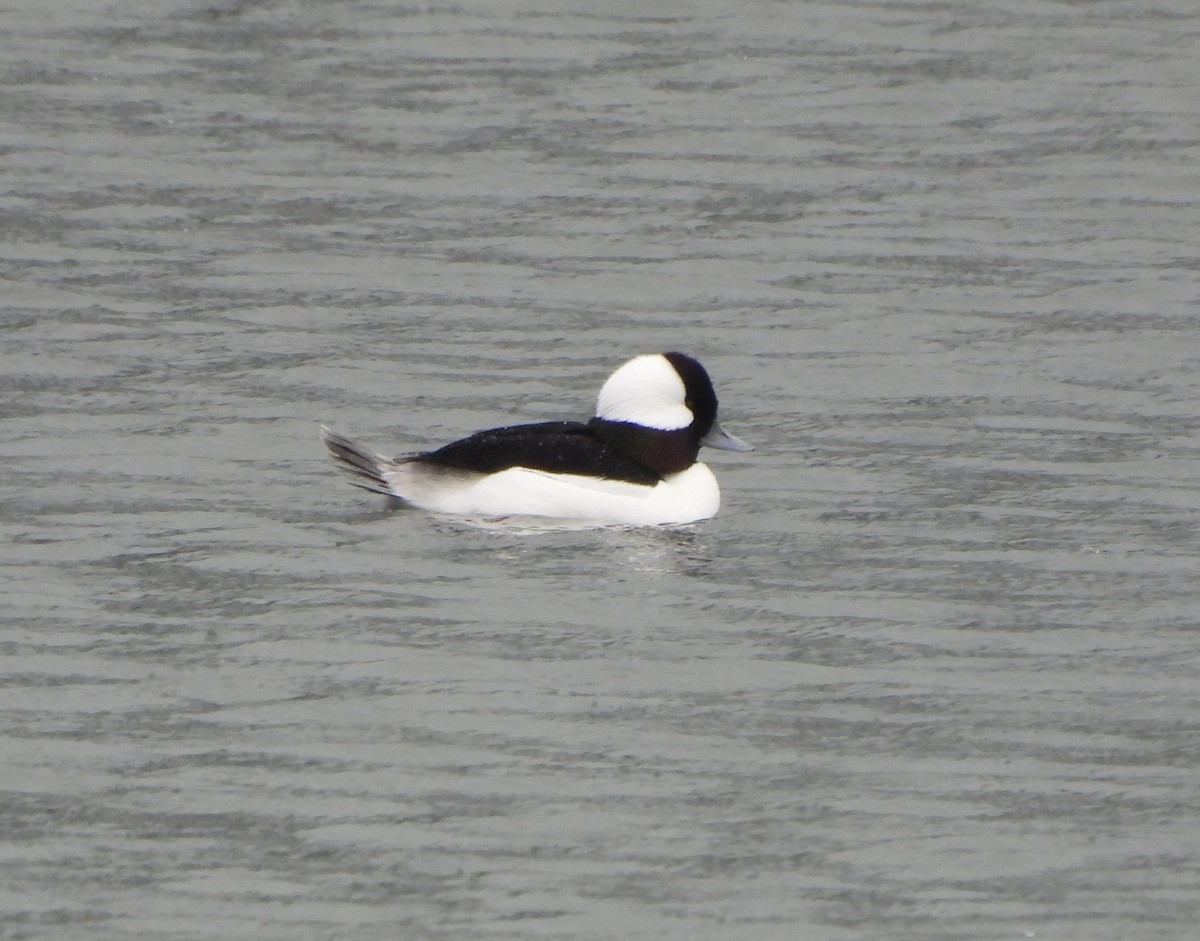
Bufflehead

photo from: https://ebird.org/checklist/S203126839

We saw this bird toward the beginning of our trip. It was easily spotted in the water due to the stark colors of its plummage which was in high contrast with the dull colored water. We identified it based not only by the color of its feathers but also by its behavior and environment. Because it was swimming around in the water we were able to rule out any shorebirds since they are not likely to be swimming in the water like this. Both were adults which we could tell from the face pattern. According to the Sibley Guide to Birds Second Edition, these ducks are common and are known to spend their winters in open lakes, harbors, and bays. They are diving ducks because their food source is mollusks, crustaceans, and insect larvae. (Sibley, 37).

Narrative: This was our shortest field trip and our last. We left a little bit later than usual because we ended up changing our site location due to the weather. It was unfortunately raining for the entirety of our trip which made it difficult to properly see the birds through our binos. Regardless, we still saw a decent number of different species.

Field Trip #11

Date- November 13, 2024

Location 1: 37°56’00.7″N 122°30’55.9″W 7ft

Location 2: 37°55’32.2″N 122°30’11.1″W 9ft

Site Description: We didn’t travel much when we got to our first site. The whole trip we were stationary and stayed within a patch of grass right outside of the parking lot. This site truly was an overlook and we got lucky that the water was low so we ended up seeing a decent amount of birds. The birds we saw while we were here included Great Blue Herons, Ring-billed Gull, Long-billed Curlew, American Avocet, Black-necked Stilt, and Green-winged Teal. There were a couple of flyovers involving a Caspain Tern, American Crows, and a Black Phoebe. For the most part a lot of the birds were recorded based on our surveillance of the marsh from this one viewpoint.

The next site did involve some traveling. We park at the end of a cul-de-sac which was located at the edge of the marsh. Once we were out of the car, we saw a Great Egret and a lot of White-crowned Sparrows. We started walking down a dirt path along the border of the marsh. It was full of different types of dense shrubbery. As we walked, we saw Bushtits, Ruby-crowned Kinglets, Song Sparrows, and House Finches. Once we made it out to a clear where we could see the water more clearly, we saw American Wigans immediately closer to the houses. On the other side that connects to the ocean, we saw another Great Blue Heron in the distant reeds and an Eared Grebe. In the distance, we also saw a Double-crested Cormorant and had a Merlin flyover. As we walked to the edge of the marsh we finally saw a Ridgway’s Rail. At the edge we saw a large amount of birds flying around. Some of these birds were Green-winged Teals and Least Sandpipers. On our walk back to the cars we saw a Western Meadowlark on the top of a flowering bush.

Species Account: Green-winged Teal 

Green-winged Teal Identification, All About Birds, Cornell Lab of  Ornithology

https://www.allaboutbirds.org/guide/Green-winged_Teal/id

We saw this bird at each location in pretty large numbers. For both instances, we were able to see the distinct greenish colored feather and patterned face. I get a better look at these birds at the second location because they were flying very closely to us and I could see the plumage details a lot better. That colored feather was almost iridescent when I saw it in my binoculars. According to the Sibley Guide to Birds Second Edition, they’re typically found in marshes or flooded fields and are typically in small groups that congregate in large flocks. These ducks are the smallest and are dabblers that will forage for food. (Sibley, 24).

Narrative: We left around our usually time of 8:10 and drove straight to Corte Madera. The first location felt really unusual because we were close to the freeway on the other side of a mall but it ended up being pretty successful. The second location was the complete opposite where we were walked right out the bay. It was a pretty cold day and we were thankfully able to beat the rain because Prof Paul took us to In-N-Out before coming back to school.

Field Trip #10- Pacheco Pond


Date- November 6, 2024

Location: 38°04’36.5″N 122°31’51.6″W 10ft

Site Description: As soon as we parked, we got a clear view of the pond. In the pond we saw Mute Swans and several duck species including Mallard and Ring-necked Duck. We also saw Snowy and Great Egrets. As we started walking to the path along the pond, we saw an Ameican Kestrel and some Canda Geese flying overhead. We got to a small group of eucalyptus trees where we saw Acorn Woodpeckers, a White-breasted Nuthatch, Chestnut-backed Chickadee, and two Bald Eagles. Within these trees were hundreds of European Starlings. We kept walking and saw hundreds of Long-billed Dowitchers and some Black-necked Stilts. We stopped at a bend where there was one main tree and a clear view of the sky. Within the tree, we saw a Downy Woodpecker and in the clear opening of the sky we saw several Red-tailed Hawks and Turkey Vultures. We continued to see more waterfowl in the pond as we walked, including Rudy Ducks, Soras, and Greater Yellowlegs. We got to a large open field towards the end of our walk down the pond, where we saw Northern Fllickers and a Northern Harrier. We stopped at a deck at the end of the pond before returning back to the car.

Species Account: Bald Eagle 

Bald Eagle Identification, All About Birds, Cornell Lab of Ornithology

https://www.allaboutbirds.org/guide/Bald_Eagle/photo-gallery

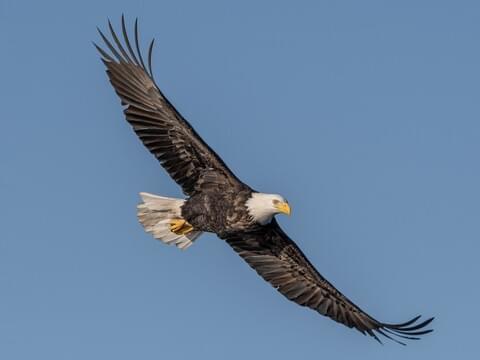
We all knew there was a possibility of seeing these birds but we couldn’t believe it when we actually did see them. One was perched at the very top of a eucalyptus tree. It is a very distinguishable bird because of it’s large yellow bill and completely white head. Also the pure size of this bird allowed us to see it very clearly without binoculars. We were able to get a good look at it before it started to fly away and at that point is when we saw the second one. According to the Sibley Guide to Birds Second Edition, their wingbeats are stiff and shallow. They are typically found near water because of the abundance of prey. It not only hunts but steals food and will typically be found perched at the top of prominent trees. (Sibley, 143).

Narrative: We left a little bit after 8 and were very lucky to have good clear skies once we left SF. This was a really exciting trip because we got to see so many different species at one site. This whole trip was on fire right after we saw the Bald Eagles. We all kept hoping they would come back so we could take a photo but we weren’t lucky twice. Regardless, we broke the record for most species on a trip. I never would have thought that pond had so much to offer.

Field Trip #9- Mill Valley Air Force Station and Mountain Theatre

Date- October 30, 2024

Location 1: 37°54’46.1″N 122°36’32.6″W 2039 ft

Location 2: 37°55’19.7″N 122°36’13.9″W 2483 ft

Site Description: We traveled up to Mt. Tamalpais and once we parked at our first location we saw a Ruby-crowned Kinglet flying around in a big oak tree. Across the way from the parking lot among some tall trees we saw a Hairy Woodpecker. We took the path past the tree through some tall cedars and this is where we saw our first Acorn Woodpeckers. Along the path, we stopped in an opening full of serpentine where we saw a Northern Flicker. We walked back to the parking lot and saw some Dark-eyed Juncos on the ground before we left.

We drove to the next location that was a little higher up in the mountain and actually used to be the tallest point before it was blown up. This space offered a lot of open views and had a wider variety of plants. Shortly, after starting on the path we saw a Spotted Towhee and a Golden-crowned Sparrow. Almost immediately after on some poison oak, we saw a Wrentit. We also saw multiple Steller’s Jays off in a distant spruce. There was a nearby overlook that we waited at and saw both a California Scrub-Jay and several Cedar Waxwings flyover. We finally climbed to the highest point where we waited for a few minutes and saw Band-tailed Pigeons, a Red-tailed Hawk, a couple Turkey Vultures, and a Cooper’s Hawk soaring high.

Species Account: Acorn Woodpecker 

Acorn Woodpecker Overview, All About Birds, Cornell Lab of Ornithology

https://www.allaboutbirds.org/guide/Acorn_Woodpecker/overview

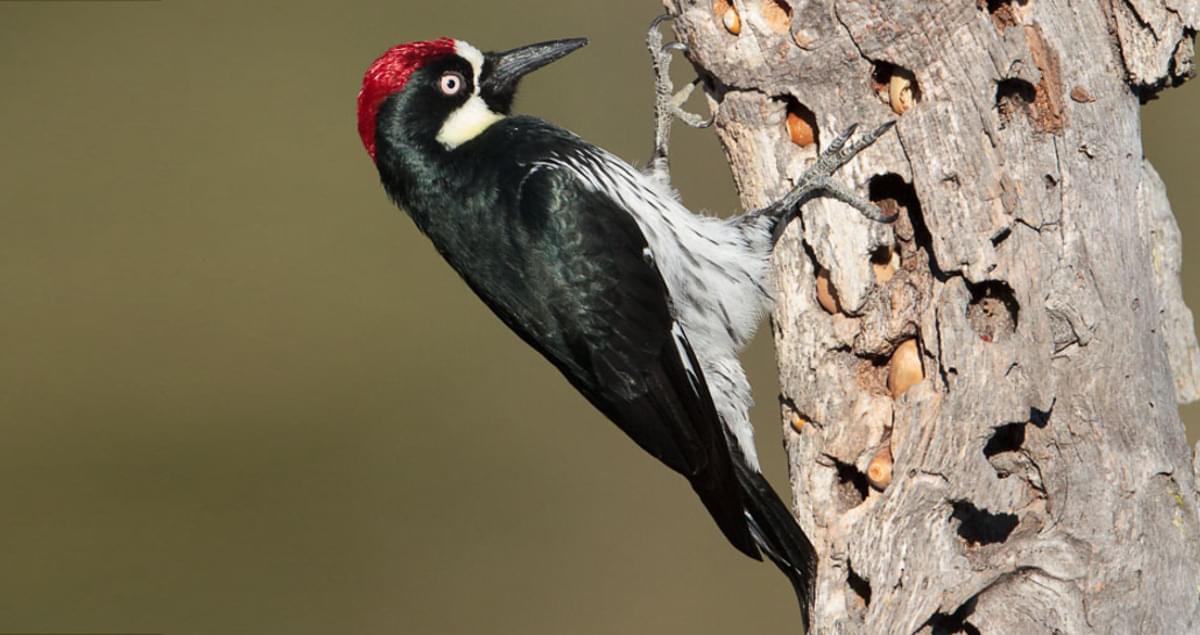
These were the main attraction for the day. We saw these birds at both of our locations. When we first identified them it was almost immediately after we got out of the car. We heard its distinct call and as soon as we got closer to the cedar trees we saw a couple high up pecking at the trunk. They had no speckled pattern on their backs and bright red feathers on top of their head. We could even make out the distinct facial pattern through the scope. According to the Sibley Guide to Birds Second Edition, they are common in open oak woods or mixed woods with oak. They gather acorns to store in holes drilled into certain trees or poles. (Sibley, 309).

Narrative: We left around 8:10 in the morning and left SF when it was a little bit cloudy. Once we got to our first location, known of us where ready for how cold it was going to be there. We are only out of the car for 30 minutes and were able to see some dead bark where the Acorn Woodpeckers had been using them to store acorns. The second location is where we spent the rest of our time. It was a little unfortunate that we didn’t see more birds even though it got a little sunny but it was still an amazing view.

Viewing Message: 1 of 1.
Warning

Important: Read our blog and commenting guidelines before using the USF Blogs network.